
Creatures of the Dark
Ghosts, ghouls, vampires and creatures of the dark. It is that time of year again where some of
us make a celebration of laughing behind a mask of fear. A time when it is funny to make
someone jump in fright. A time to set off loud explosions to ooh and aah at. A time to burn a
human effigy of an historical anti-hero on a huge bonfire. Harmless? Or is it?
How many of us are genuinely scared of shedding light on the “creatures of the dark”, aka, our
emotional trauma? How many of us have become so adept at wearing an “I’m totally fine”
mask? How many of us are burning inside with unexpressed emotions?
As an art therapist, or any therapist for that matter, it is inevitable that we will be holding the
emotional outpourings of our clients. But how does this actually work? And what do we do with
these surrogate emotions? Where do we put them? How are they stored between sessions so
that they can be “taken out of storage” again when the original guardian of the emotion returns
for their next therapy session? Sometimes an emotion will be born into the therapy space and
not looked at again for several weeks while other threads of life’s challenges take their turn in
occupying centre stage. The therapist still has to keep these emotions safely stored somehow.
Sure, there are professional practice guides to adhere to, information governance rules to obey,
and confidentiality agreements to uphold. However, through the medium of art therapy, these
emotions take physical form in the creative non-verbal expression process. They become very
present in the room. They can take on a physical personification of the emotion. We sit together
and develop relationships with these externalised emotions. They are unapproachable
sometimes, they are rejected sometimes, they are painted over and over and over in covers of
“I’m not ready to let you be seen” sometimes. They are questioned, talked to, listened to, and
finally left in the therapy space to be looked after by me, the art therapist.
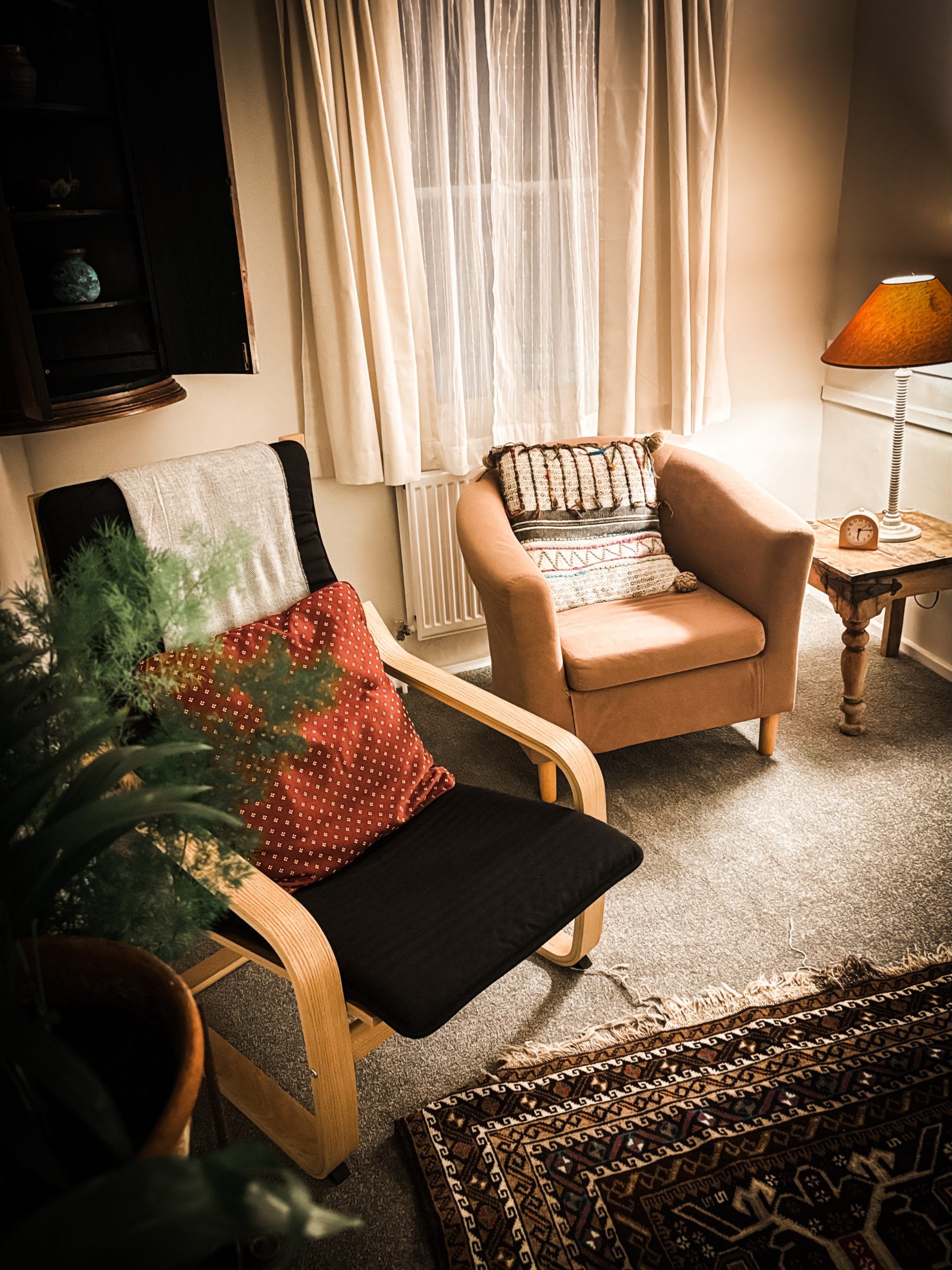
Now, I work in The Practice Rooms which is predominantly a space for therapies that don’t have
the by-product of the physical manifestations of the clients’ emotions. Hence there is no safe,
secure and protected on-site storage for such objects. I take my duty of care seriously and so I
carry these objects home with me and lock them in a cupboard. I have a box of trauma, a mask
of truth, a page of tears, a blob of anger, a tangle of stress and a little object of strength, all in
my care. Never mind the depression. There is a fair amount of that in the cupboard too. A3
black, black, black and murky. Heavy.
Every morning, in front of my huge, light portal of a window, I take 30 minutes of self care. I
stretch my body. I breathe out all that needs exhaling. I tell myself caring words. I ask for
forgiveness and offer forgiveness. I then say good morning to myself and everything around me,
including Amica, my turquoise fridge who usually stops humming to kindly consider me in this
small morning window of self love.
The contents of the locked cupboard do not infiltrate into my non-therapy days, but what does
cross my mind from time to time is the subject of vicarious trauma. This term pops its head up
frequently and generally affects people in the field of care-givers such as mental health workers,
people in the forces, people in services such as the prison and police force, and of course,
therapists. That is, those who listen to other’s trauma regularly.
I met a friend of mine, a burly chap of ample strength, a formidable man who has been in the
forces. He shared that Halloween is a time where he will be hiding at home with noise cancelling
headphones and distracting decibel deafening music playing to drown out the shock stimulus
that firework bangs will be: over and over and over again. If you may have been in the forces
and witnessed gunshot as death, explosion as destruction, and loud noises as threat, how easy
is it, realistically, to look at a “dark demolisher” exploding in the sky and feel “oooooh”?
Paint your face as a ghost, or draw your ghoul. You choose. Here, in my art therapy space, I will
hold your creature of the dark until you feel ready to introduce it, gently, to the light. And say
good morning.
A new day may be about to dawn.